substack.com - The Great Circle of Life
First, Consumer. Then, Software. Now? AI?
Section titled “First, Consumer. Then, Software. Now? AI?”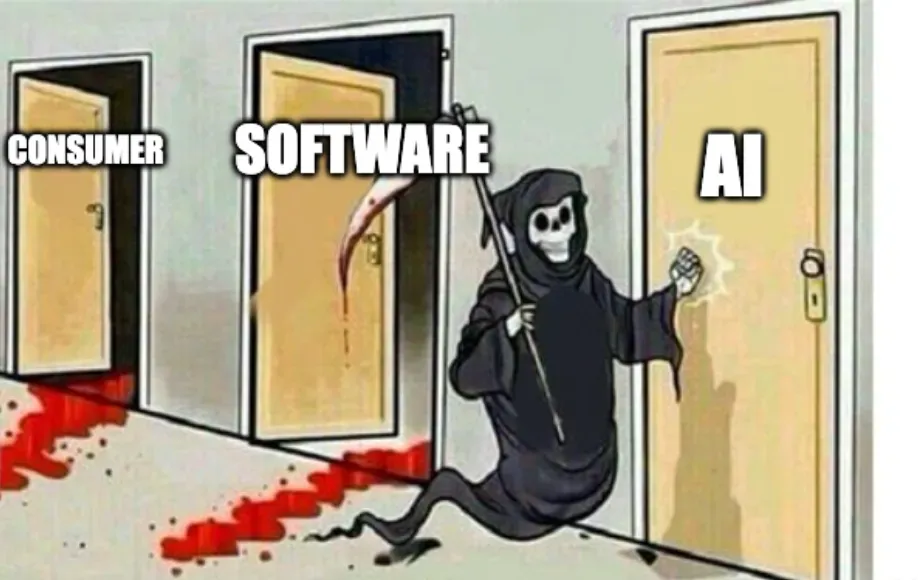
This is a free weekly newsletter about the art and science of building and investing in tech companies. To receive Investing 101 in your inbox each week, subscribe here:
“Death begets death begets death.” (Lorn au Arcos; Golden Son)
Technology has experienced any number of cycles. Some, like the internet and AI, have created super cycles that lead to massive speculative economic bubbles (e.g. the Dot Com and…whatever we’re calling this). Others have created fertile playing fields, like SaaS and mobile.
But, like any cycle, it includes ups and downs. Rising and falling.
When I started my investing career in 2014, investors still branded themselves with deliberate monikers attached to particular tech cycles. People thought of themselves as “internet investors” or “software investors.” They build specialties around specific categories, playbooks, and replicable motions.
Increasingly, those labels are meaningless. Every technology company uses the internet. Each of them leverages SaaS, mobile, and now, AI. To call yourself an AI investor, today, feels trite. Whether you like it or not, we’re all AI investors.
But what the rapidly increasing speed of these tech cycles feels like its doing to all of us is increasing our appetite for death.
Consumer Is Dead
Section titled “Consumer Is Dead”Consumer investing, arguably, lasted from 2005 (founding year of companies like Reddit and Yelp) to 2016 (founding year of TikTok). Since then, “consumer investors” have been desperately searching for the next great consumer platform. They tried D2C commerce, subscription boxes, scooters, incidental social, like BeReal, etc.
But, arguably, the only consumer platform to be build in the last 10 years, was ChatGPT. And most, if not all, of them missed it.
Software Is Dead
Section titled “Software Is Dead”Software had a bull run from 2008 to 2019. Since then, a lot of people would argue that software has been propped up by zirpy free money environments and, as a result, have seen massive bloat both in headcount (and its dark spectre; stock-based compensation) and S&M spend.
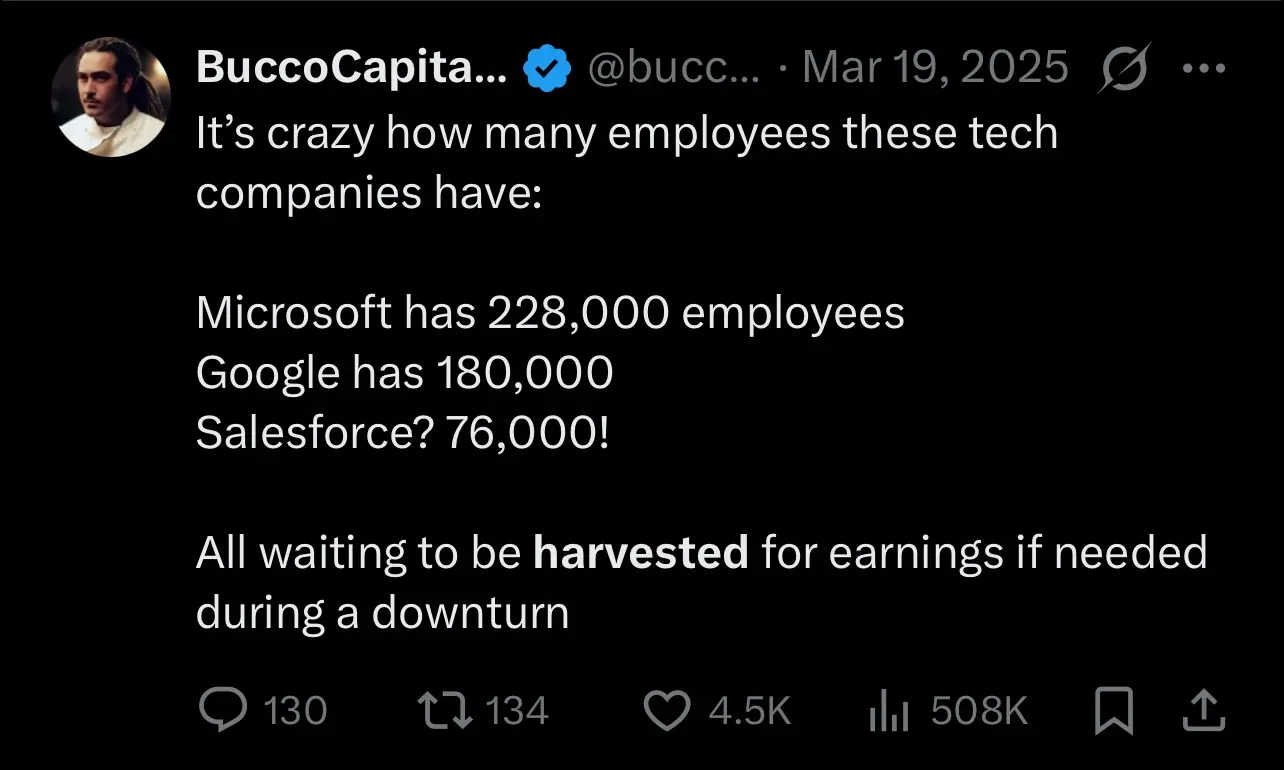
Source: Twitter
I don’t buy into the SaaSpocalypse doomerism that people are just going to vibecode SAP. But there is a fundamental question of what these “terminal value” SaaS companies are really worth. And no one has a good answer.
AI Is Dead?
Section titled “AI Is Dead?”The feeling of consumer having been dead for a while and SaaS increasingly seeming like a zombie seems to have made people addicted to seeing death in the face of everything around them.
With AI, there are plenty of perma-bulls; horny for the latest doomer claim from Dario or whoever else, saying that we no longer need mothers and fathers, because AI will raise our kids, and its only a matter of time before we replace Congress with “sovereign AI”, whatever that means.
And there are AI perma-bears who are convinced its fake, or simple, or incapable of ever driving real business value. They breathlessly share the latest stat of how little business ROI the most recent batch of AI projects are actually yielding.
But even those less prone to shout “the emperor has no clothes” about AI seem intent to look for the signs of rigor mortis forming amidst the AI giants. Take, for example, OpenAI’s stumbles over the last few weeks.
In-chat shopping isn’t converting the way they thought it would (so says their partners at Walmart), business adoption is slow (so they’ll spend $10B with PE firms to deploy it), consumer adoption of ChatGPT has slowed (they thought they would blow past 1B users, but at EOY 2025, they slowed and have barely reached 900M).
So, now, they’re starting to refocus the business. No more Stargate, no more in-house chips, internal hardware, etc. Even more telling, they’re shifting focus away from consumer and going more all in on enterprise coding, where Anthropic has dominated.
But what’s really happening?
Adoption Behavior Has Metastasized
Section titled “Adoption Behavior Has Metastasized”On the consumer side, I think there was a handful of mega businesses that got build right as we were all coming online and our consumer behavior formed around their products. But since then, that usage has metastasized and failed to evolve much beyond where it landed in ~2016.
On the enterprise side, the consumerization of the enterprise has followed a very similar trend. We’re not rapidly adopting fundamentally new products. We’re frequently searching for the N+1 improvement to our existing workflows.
In terms of AI, there is clearly a different story. Countless AI companies have scaled first to $100M ARR, then to $1B ARR so rapidly. Clearly something magic is happening, right? Well, there’s a couple things we need to parse:
- (1) Some AI traction is exaggerated: A LOT of AI revenue numbers are taking their highest performing week and multiplying it by 52. Or annualizing free trials as if they were paid. Or just straight up lying because no one is checking. That doesn’t mean ALL AI revenue is fake. But a good portion of it is not adequately reflected in reality.
- (2) Experimentation is in vogue: A lot of AI revenue is coming from experimentation budgets. People feel intense pressure to deploy AI, so they turn on the budget to make it happen. Their CEO or CTO or COO has had an incredible experience with Claude Code and suddenly pushed the entire org to figure out how to get that same “AI experience” elsewhere in the business. How durable that revenue is? Time will tell.
- (3) AI turtles all the way down: A good chunk of the value chain of revenue ramps that we’re seeing are coming from labs that need data, model companies that need inference, and applications that need tokens. AI paying for AI to pay for AI that pays for AI. Everything from circular deals to booking revenue that you then buy back as a cost. This is the most difficult layer to parse because its opaque.
None of this is to say that AI is fake. But AI is still very similar to the obstacle of a metastasized adoption universe that we’re already seeing in consumer and enterprise. Its just that factors, like the three I listed above, make it more difficult to see that behavioral limitation. But its there.
The Pill Analogy
Section titled “The Pill Analogy”Over and over again, I return to this pill analogy for AI. Its, candidly, where we’re spending the most time. You can have a really effective protein (AI) and a really nasty disease (human workflows) but you still need a delivery mechanism to get the drug into the body (the pill, or, in this case, applied AI).
We have a lot of people focusing on the cutting edge. And I think thats great. There’s a whole ecosystem of researchers spinning up massive amounts of compute, training, inference, and test cases to rapidly improve the quality of the models and architecture we’re leveraging. That’s the equivalent of the fiber that got laid down in the Dot Com. It will eventually get used, whether or not the demand materializes now or more over time.
But what I see very few people paying attention to is just how much people are overwhelmed by their digital processes. They don’t have a good delivery mechanism to get, what is clearly a capable drug, into their disease.
And until we confront the reality that AI, like software and consumer before it, is butting up against the ornery stubbornness of human behavior, we’ll keep assuming that the deployment curve is occurring as rapidly as the development curve; but that just isn’t true.
“Consumer is dead.” “Software is dead.” “AI is dead.” That’s the morbid addiction talking. What is instructive is not perpetual pessimism. The most informative element of this dynamic is acknowledging the obstacles that exist in deploying the latest and greatest technology effectively, and leaning into that messy process.
Thanks for reading! To receive Networked Conviction: My Investing Journal, a collection of portfolio updates, Requests for Startups, and investing ideas for paid subscribers, you can sign up below: