excel.holdings - Systems of Action and the Dominos Pizza Tracker Product Model
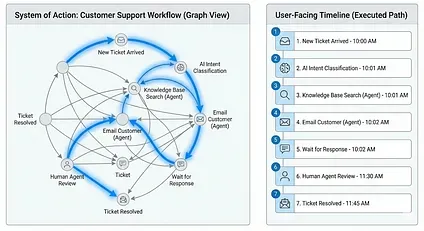
I’ve been thinking a lot recently about agentic systems and the shift in how we actually get work done. We’re entering a phase where AI agents aren’t just “chatbots.” They are starting to take over massive chunks of the workflows humans used to own end-to-end.
This shift changes the very foundation of how we build software. For decades, SaaS was built around Systems of Record. But the future? The future belongs to Systems of Action.
The Death of the Discrete Object
Section titled “The Death of the Discrete Object”When you think about traditional SaaS, it’s centered around discrete objects. Think of a library: you have a book, a genre, and an author. The software is just a way to query those objects. It’s a database with a pretty interface.
There’s a lot of noise right now that Systems of Record are becoming “cheap” to build, and that the cost of this kind of software is going to zero. Maybe it will. But the real reason the old model is fading isn’t just cost; it’s utility. Users don’t just want to store data anymore; they want the data to do something.
The “Domino’s Pizza Tracker” for Work
Section titled “The “Domino’s Pizza Tracker” for Work”While a System of Record is centered on objects, a System of Action is centered on timelines.
I like to describe it as the “Domino’s Pizza Tracker” for any unit of work. Whether a human is doing the task or an agent is doing the task, the system tracks the progression of that work in real time.
Behind the scenes, a developer sees this as a graph, specifically a directed semi-cyclic graph. Each node is an action:
- An LLM processing a request.
- A tool call to an external API.
- An agentic loop where the AI self-corrects.
- A “Human-in-the-Loop” moment where a person needs to sign off.
But the end user doesn’t need to see the “spaghetti” of the graph. To them, the “truth” of the system is just a clean, linear timeline of nodes visited. It’s the story of how the job got done.
Why This is the New Moat
Section titled “Why This is the New Moat”This is where it gets fascinating: Systems of Action allow you to build proprietary IP into the execution of the job.
To build a great agentic system, you need incredibly detailed insight into the “Jobs to Be Done.” You are essentially compressing complex human workflows into a digital timeline. By owning the sequence of actions, you are building a deeper level of intelligence into the product than a simple database ever could.
The User Reality
Section titled “The User Reality”There’s all this noise in the industry right now about “context graphs” and other technical buzzwords. Maybe that matters under the hood, but to the end user, it shouldn’t. The truth is that the system of action should just look like a timeline. It should be a transparent record of discrete events, human-driven or agent-driven, and the ability for the user to see that the whole agentic system is tracking everything.
We’re moving away from software that just sits there and waits for you to type. We’re building software that moves.