Canonical Everything
- clippings
Every time I get involved in an existing project, I ask one question to get ramped up: “Where can I find out what I need to know?”
Ideally, information this basic already exists in one place. But most of the time, I get different answers from different people. Or, no one knows. I should not have to play detective in order to learn the goal of a project, different areas of work, or where to go to learn more.
All this not only makes it hard for new people, it also means that everyone on the team does not have Extreme Clarity. We are not all on the same page because this page literally and metaphorically does not exist.
So, whether I’m jumping into an existing project or starting a new one, I always want to have on hand the “one and only” document that has all the basic information everyone needs to know. I call this the “canonical” document, as in: the official document, the one that belongs in the canon.
Canonical Doc
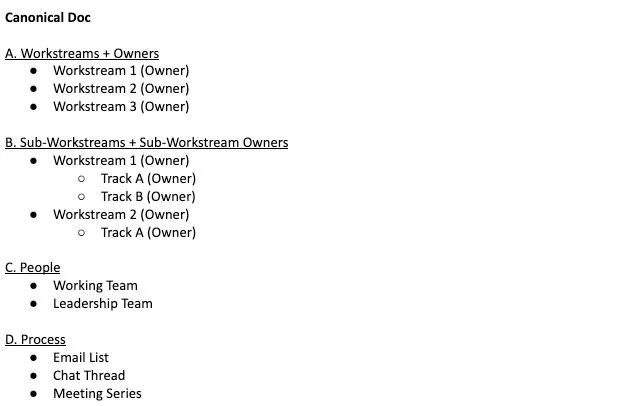
Section titled “Canonical Doc”A Canonical Doc is the one doc to rule them all. It has all the basic and critical information about a project, with access to all the other downstream and detailed information linked to from there.
It’s a hassle to have to find all your different documents. By linking out to them from a single Canonical Doc, everyone will only have to bookmark one thing to quickly get all the information they need.
Canonical Workstreams + Owners
Section titled “Canonical Workstreams + Owners”Your Canonical Doc should list out the logical and discrete areas of work for your project. Each workstream should have an owner. To keep things organized, for every workstream, write down who owns it:

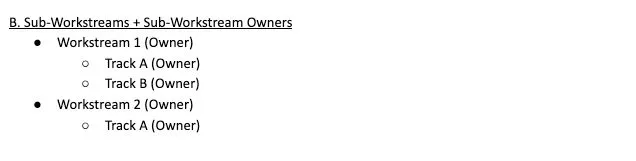
Sometimes, workstreams are so large that they need to be broken down further into sub-workstreams. Each sub-workstream or “track” should also have an owner. Write it down.
Canonical People + Process
Section titled “Canonical People + Process”Your Canonical Doc should also answer this simple but important question: “Who are the people working on this?” List out everyone on the working team and leadership team.
These people should communicate with each other through a canonical email list, canonical chat thread, and canonical meeting series. This is important to avoid conversations happening in parallel, missing context, and various times when people are accidentally left off emails/chats/meetings.
If you’ve ever been left off a message chain, it’s not a great feeling! More importantly, it slows down the work.
One of the most important lessons about “Canonical Everything” is recursion — Canonical Everything recurses! Meaning, every workstream has to have its own Canonical Doc that is linked to from the overall Canonical Doc.
Canonical Nomenclature
Section titled “Canonical Nomenclature”I’ll sometimes hear people use the same words but mean different things, or use different words to mean the same things. This leads to confusion and misunderstanding. Clear communication requires a shared vocabulary; a commonly held list of words and definitions. (Of course, this extends beyond words, to frameworks and visuals).
Setting a good example, I would define each of the following three concepts as:
- Canonical Nomenclature: the vocabulary to talk about a problem
- Canonical Framework: a way to think about a problem
- Canonical Visual: a way to visually represent that framework
For example, in the early days, I was in a meeting where the terms “consistency” and “accuracy” were being used interchangeably. These words mean very different things. We were happy that consistency was high, but not if we were consistently making the wrong decision.
So we wrote down what we really meant:
- Consistency: the % of the time content reviewers agree on a decision
- Accuracy: the % of the time we make the right decision
As a result, our ability to communicate with Extreme Clarity improved.
On a final note: it is especially critical to establish canonical nomenclature when you’re working on new projects, where there is no common jargon or mutual understanding yet.
Canonical Framework + Visual
Section titled “Canonical Framework + Visual”A Canonical Framework is a way to get everyone to think about a problem in the same way. A good framework is enduring and survives for years because it remains the right way to think about that problem. Of course, what’s the best way to make sure that everyone understands the framework? Visualize it.
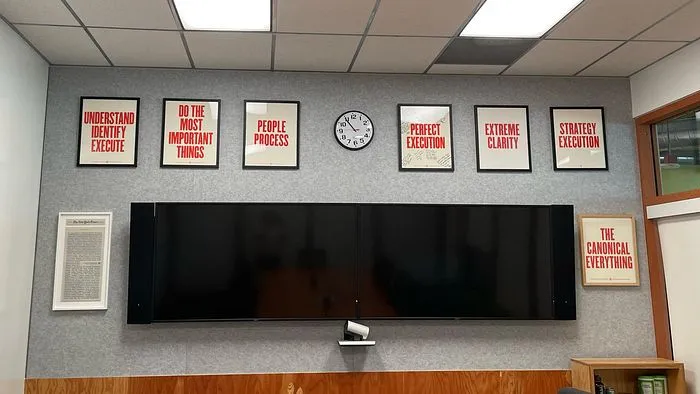
To celeberate my 15th “Faceversary”, my team got me a poster that says “Canonical Everything”, it now hangs in my office with some of my other “Naomi-isms” 😊.
What canonical frameworks and visuals do you use?